

Ecuador
Ecuador
Four worlds in one country: a UNESCO capital in the clouds, wildlife unlike anywhere on Earth, Andean cloud forests, and the edge of the Amazon.
Welcome to Ecuador, where volcanic peaks, UNESCO-protected colonial cities, and wildlife encounters found nowhere else on Earth come together to create an extraordinary family destination. In a country roughly the size of Colorado, you can stand at the literal center of the world in Quito, snorkel with sea lions in the Galápagos Islands, slow down on a working hacienda in the Andes highlands, and hear the Amazon rainforest come alive at dusk — all in a single trip.
Ecuador has quietly become one of the most accessible international adventures for families traveling from the US. Flights connect through Miami, Houston, and Atlanta directly into Quito, and because Ecuador uses the US dollar, there’s no currency math to stress over. Best of all, Ecuadorians are famously warm and welcoming, children are celebrated everywhere you go.
Capital City: Quito
Population: 18 million
Main Cities
Culture
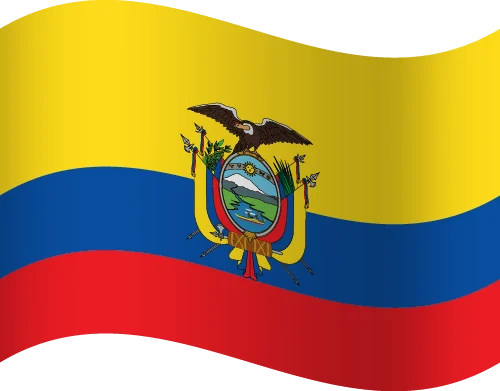
The colors of the Ecuadorian flag carry deep meaning. Yellow, the widest stripe covering half the flag, represents the country’s natural abundance and the warmth of the equatorial sun. Blue stands for the sky above and the ocean surrounding the remarkable Galápagos Islands. Red honors the courage of those who fought for Ecuador’s independence. The national coat of arms sits proudly at the center.
Ecuadorians are known for their extraordinary warmth and hospitality, and children are welcomed with open arms everywhere you travel. Ecuador is home to more than a dozen Indigenous nationalities, and you’ll find beautiful handcrafted textiles, music, and traditions woven into everyday life, especially at highland markets like Otavalo, one of the largest and most colorful Indigenous markets in all of South America.
Language
Language: Spanish
In major cities and at most Galápagos lodges, English is widely spoken. But even a handful of Spanish words will earn you big smiles from locals, especially from kids at market stalls and hosts at highland haciendas. Here are a few words to practice before you go:
Here area few words you will find helpful. Bring a tour book or a Spanish-language book to help you on your trip.
| English | Spanish | Pronunciation |
|---|---|---|
| Hello/Goodbye | hola | (OH-la) |
| Goodbye | adios | (ad-dee-OHS) |
| Thank You | gracias | (GRAH-see-ahs) |
| Yes | si | (SEE) |
| No | no | (NOH) |
| 1 – One | uno | (OO-noh) |
| 2 – Two | dos | (DOHS) |
| 3 – Three | tres | (TREHS) |
| 4 – Four | cuatro | (KWAH-troh) |
| 5 – Five | cinco | (SEEN-koh) |
Main Cities & Areas
Quito: Culture, History & the Equator
Ecuador’s capital city is an incredible place to begin your adventure.
Set at nearly 9,000 feet in the Andes Mountains and surrounded by volcanoes, Ecuador’s capital immediately feels dramatic and unique. The city stretches roughly 40 miles north to south through the mountains, creating incredible views in every direction.
The Historic Center of Quito is a UNESCO World Heritage Site, one of the first in the world to be designated as one. It is filled with beautiful architecture and cultural experiences. At Basilica del Voto Nacional, we climbed the Condor Tower for sweeping city views and discovered gargoyles shaped like Ecuadorian wildlife. Inside, the stunning rose window is inspired by orchids—fitting for a country that is home to more than 4,000 native orchid species.
We loved visiting Yumbos Chocolate, where we learned more about Ecuador’s world-famous cacao, tasted different varieties of chocolate, and even created our own custom chocolate bars with the help of our host, Jared.
Just outside the city, we visited the Intiñan Museo de Sitio at the equator—“Intiñan” means path of the sun—where KeeKee stood with one paw in each hemisphere!
And of course, the food was unforgettable, from traditional potato soup at Claroscuro to tasting fresh paila, a hand-crafted sorbet-like dessert made in giant copper bowls.
We stayed at the new 5-star, sustainable, and very family-friendly Go Quito Hotel. It has a spa, an indoor pool, and a rooftop restaurant, with volcanoes surrounding the skyline. Be sure to try one of the local specialty drinks like the warm canelazo, a traditional Ecuadorian drink at the Parallel Lobby Bar.
Galápagos Islands: Wildlife & Wonder
The Galápagos Islands are unlike anything in the world.
Made up of 13 major islands, countless smaller islands and rocks, and several active volcanoes, the Galápagos feels like stepping into another world.
Known for their extraordinary biodiversity and for inspiring Charles Darwin’s theory of evolution, the Galápagos Islands are one of the most fascinating natural destinations in the world. The islands were named after their most famous resident…the giant tortoises, or “galápagos” in old Spanish.
During our North Expedition aboard Go Galápagos‘ Galapagos Legend, a 100-passenger expedition ship designed for exploring the islands, and led by incredible naturalist guides like Emil, we experienced unforgettable wildlife encounters every day.
Sea lions lounged beside walking paths and beaches, giant tortoises roamed freely in the highlands of Santa Cruz, and marine life surrounded us both above and below the water.
We explored mangroves filled with sea turtles, rays, and baby sharks at Black Turtle Cove, watched frigate birds inflate their bright red pouches on Genovesa Island, spotted all three types of boobies—including the iconic Blue-footed Boobies on South Plaza Island—and snorkeled alongside playful sea lions and sea turtles in crystal-clear water. And we visited the El Chato Tortoise Reserve to see the giant tortoises, which can live for more than 200 years.
It’s one of those places that leaves a lasting impression on both kids and adults alike.
Andes Mountains: Nature & Connection
We ended our trip with a lovely family stay at Hacienda San Martin in the Andes Mountains, about an hour outside of Quito.
Located in Nono, in the foothills of Mount Pichincha and at the start of Ecuador’s cloud forest region, Hacienda San Martin feels peaceful, authentic, and deeply connected to nature.
Here, we slowed down and experienced:
- Horseback riding through the countryside
- Helping on the farm—feeding chickens, goats, and more
- Hiking to a beautiful waterfall
- Feeding hummingbirds right from our hands
- Meeting a local woodworking artist and hand-painting a sparrow carving to bring home
One of the most incredible experiences was visiting Zuro Loma, where hummingbirds landed on our hands to feed while we were surrounded by the beauty of Ecuador’s cloud forest. Ecuador is home to more than 200 species of hummingbirds, with different varieties found at different elevations.
What made it truly unforgettable was the people. Francisco and his family welcome you into their home with such warmth, incredible home-cooked meals, and a genuine sense of hospitality.